
-Mark Twain
Gutenberg's printing press had the most important impact on the development of mass communications. It allowed works to become mass produced, and with that, new ideas of change spread all over Western Europe. Gutenberg's printing press made it much more convenient to print and copy works; rather than hand-writing every book (which could take years) the printing press allowed much quicker copying times. Though there were many ideas of different types of printing presses circulating around the time of Gutenberg's invention,Gutenberg beat them to it, and almost instantly changed the world.
In this video, Rusty Maisel explains the inner-workings of the printing press, like the cotton paper that was used as the paper to be printed on, as well as how the wooden-block lettering mold that was created to be pressed around the paper. He also explained that Gutenberg himself did not solely create the printing press, nor the paper nor the ink that was used for it, he simply was the first to put them all together. Though he does commend Gutenberg for all that he has contributed, because without him and his invention there would be no Renaissance, Reformation, or really any widespread literary knowledge. Gutenberg's printing press hardly changed from the time of it's invention and over the next 350 years, but still managed to have books and other forms of writing spread like wildfire.

Here is a drawing of what a printing press-room looked like around the time of its invention. You can see from the picture that forming printed works was quite a physical job but worth the reward once a literary work was complete.
Gutenberg's printing press created a chain of education and awareness that spread all over Europe, and over the years, to America. The Gutenberg press allowed Bibles (something that the public at large had very little access to) to be mass printed. Before his invention only the clergy of the Catholic church had possession of the Bible, and even then, it was written in Latin. But with his invention as well as the addition of Martin Luther's German translation of the Latin Bible, people had better access to the true meaning of the Bible, rather than what the Catholic Church was enforcing unfairly on it's people (i.e. indulgences and unfair taxing). In fact Gutenberg even published his own bible (pictured below), with over 200 copies being printed and distributed around Europe. This too, sparked the will to learn to read and write, and to become involved and educated around them.
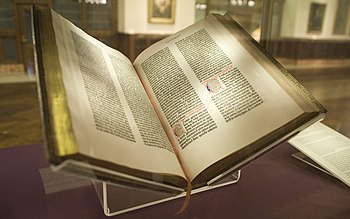
Gutenberg's Bible
