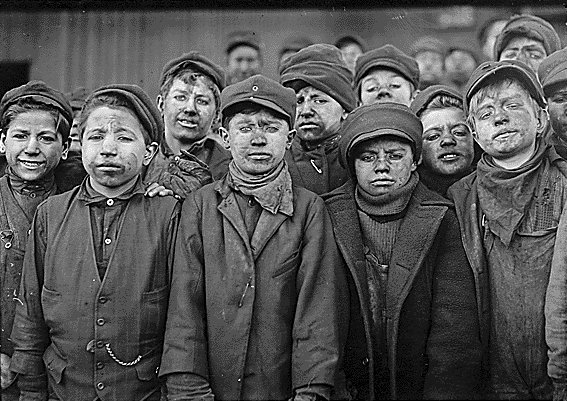
During the age of New Journalism, beginning in the mid 1860's, newspaper and magazine companies became larger, richer and more competitive. Circulations of newspapers increased and news traveled quicker than ever before thanks to the invention of the telegraph. To give an edge to the news companies, they hired special correspondents across the ocean to report on news occurring in foreign countries. Ideas such as visual journalism (i.e. pictures, comics, and political cartoons) were introduced to make newspapers eye-catching. During this time conditions in the United States were grim: poor immigrants were flooding into the country seeking the American Dream and African Americans were free, but still extremely discriminated against. It was also the time of the Industrial Revolution, where children were commonly seen working in factories under horrible conditions. These harsh conditions the United States and its citizens were going through during this time inspired journalists to expose corruption and encourage change, hence the beginning of muckraking.
Child Laborers during the Industrial Revolution
Muckraking stories sold well with newspapers and magazines, especially with exaggerated titles, eyewitness interviews, and undercover investigations. Muckraking articles main purposes were to expose any corruption, governments inefficiencies, as well as day to day crime. One undercover operation was undergone by a woman named Nelly Bly. Nelly Bly was a muckraker and journalist who was hired by Joseph Pulitzer and wrote in the newspaper, The New York Herald. One of her most famous exposing articles was published after she stayed at Blackwell's Island Asylum, acting as a mental patient. Here she witnessed and unwillingly partook in the horrifying conditions there, such as beatings, forced meals, and ice-cold baths. With this experience, she published an expose on the harsh conditions that women undertook when staying at Blackwell's, and in the end, her accounts brought in reform and money to the institution.
Nelly Bly
Bly's book about the asylum.
A video dedicated to silently telling the beginnings of Nellie Bly's career.
Muckraking magazines such as, McClure's, Munsey's, and Cosmopolitan, targeted mainly the middle-class as its readers. Journalists who worked for these magazines saw it as their job to provide the public with information of corruption, make knowledgeable the imbalance of the rich and the poor as well encourage change for the underprivileged. Many muckrakers believed that the politicians and businessmen of the time were corrupt and selfish and should instead should have had the best interests of the public at heart. Some notable muckraker magazine journalists were Upton Sinclair, Lincoln Steffens, Jacob Norris, and Ida Tarbell. One significant moment in muckraking history was Upton Sinclair's publication of The Jungle, which undercovered the abhorrent conditions of the meatpacking industry, resulting in the creation of the FDA, the Meat Inspection act,as well as the Pure Food and Drug Act.
A glimpse at the Meatpacking Industry during the early 1900's.
An insightful video about muckrakers existing in the Progressive Era
The popularity of revealed truths exposed by muckraking journalists and magazines influenced many modern magazines. Muckraking, at it's beginning was used to expose corruption and misdoings, but evolved into shock-value news and in some cases simply shock-value entertainment, which we see in today's magazines. Although their is a wide range of reporting today, with magazines like Time and Newsweek, who have stories that do cover topics similar to early muckrakers, their is also magazines such as The National Enquirer, who will publish half-truths, exaggerations, and sometimes even lies in order to sell their magazines. Ultimately, without muckraking we would not have the magazines we have today.
Before the time of the Penny Press, newspapers were too costly for the average person to be able afford on a daily basis. The newspapers cost around six cents each, and their main topics focused mainly on politics and commerce. Once the idea of the one-cent Penny Press newspaper was established in 1830, it completely revolutionized how newspapers were produced, distributed and funded. With new technology arising during this time, newspaper companies were able to quickly produce and print newspapers at a rate cheaper than ever before. Before the printing press, newspapers were sold in expensive subscriptions (how many newspapers of the time earned their profit), but with Penny Press, newspaper companies were able to sell the penny papers one day at a time and rely on advertisers for earnings.
The Penny Magazine: A early penny paper in England that aimed to educate and improve the lives of the lower class in England. In just a year of it's proudction it had a circulation of more than 20,000 copies, with a large following in the US as well.
Before the Penny Press, the main readers of newspapers were the educated elite who could afford the high price of newspapers. The Penny Press adapted to their now large, less educated audience, by selecting words and phrases that were easier for the public at large to understand. This allowed everyone to be involved in the conversation.
An early look at the first popular Penny Press paper: The New York Sun
As the Penny Press papers began to gain popularity, competition arose, and journalists began dwelling on what the average person could relate to and be interested in: social life. Local news was now discussed in the paper including social events and outrages, police reports, as well as the gossip of private affairs. Early newspapers were controlled by the government, so therefore were heavily censored to the governments liking, but now newspapers were owned privately, allowing the newspapers to post their own stories, thoughts, and opinions (to an extent) with little to no repercussions enforced by the government.
The Spirit of the Times, a sports and theater paper.
Today, we can thank the Penny Press for its influence on modern journalism by recognizing it's lasting effects. One lasting effect is the press associations that formed during and since the creation of the Penny Press. Press associations provided news stories to companies who couldn't afford to send their own reporters out on the field. These companies would then pay the press associations a fee for using the story. The introduction of the telegraph, which allowed for messages (i.e. news) to be sent from across the country (or countries) in a matter of seconds, set the definitive norm for the immediacy we see in the media today. Stationed correspondents from Washington D.C. were hired for the first time, allowing news straight from the government to be dutifully reported back to the particular company the reporter was working for. Finally, probably the largest effect the Penny Press had on modern journalism was that journalists began to see the value in objectivity and quality in reporting. Also just a fun fact I discovered when I was searching for information on this topic: there's an actual Penny Press game that is in development! Check out the Kickstarter campaign!